- Automate saving and investing. When you automate something you make something that is hard for most people easy to accomplish. You learn how to live on less when the money is not in your account. This is due to the money being less accessible and often having to pay penalties to access it.
- Automate bills. If you can minimize how many transactions you manually pay then you lower your decision fatique and make better choices.
- Anchoring. Anchoring an amount you want to save can help you achieve your goals. Setting an expectation that is reaching but achievable can give you a goal to hit.
- Require Purchase Downtime. Require a week of considering a purchase before you make a purchase in a certain category or over a certain amount.
- Framing. Frame your savings as life or security purchased. You can strengthen this mindset by reflecting on the power of compounding over long periods of time.
Millionaire Librarian
A Middle Class Path to Early Retirement
-
-
I watched a youtube video of a fiancial adviser and she was talking about why she quit the business. Many of her points resounded with why I have been hesitant to jump into it. Here is a summary of some of her points.
Advising is selling and confidence sells best. She mentioned that her knowledge of the financial markets impacted her confidence because she understood the complexity which dampened her confidence and ability to sell. In contrast, new advisors who knew little but were confident could close despite their advice and knowledge being worse.
The people who need your advice and the people who you can make money off of are not often the same people. Lower income people desperately need financial literacy. The problem with helping them is that the asset under management fee structure system makes them unprofitable to help despite being very needy. Rich people pay you well for managing their money but often you are just helping them go from rich to extremely rich. This reality can be desparing.
Other items that makes the career less appealing is that often the first couple of years your income will be very low while you “build your book” of clients.
-
I am semi-retired. I may have to work sometime in the future again, but not right now.
Here are some items on my mind.:
Social security. I may be able to get on social security disability to assist with early retirement. We have a doctor’s appointment scheduled for next month.
Federal retirement disability. Though this is a relatively small amount of money, we are also applying for this.
We are also looking again at retiring in Panama, specifically Volcan. It seems to have a slightly younger group of expats. Many of these expats have children. By our best approximation we could pull the trigger in about three years after Lauren has her student loans forgiven. These three years would allow our money to compound for a little longer and some unknowns like social security to become known.
I have started working on my Spanish at the local library. The group I joined is very advanced and beyond my level but it is interesting exercising that muscle again.
We are also very close to hitting a arbitrary but significant financial milestone. Though there are psychological risks to mentally “anchoring” on a number I think the process may potentially ease some anxiety if we stay above the milestone.
-
This post has been running through my head the last couple of months:
Like JL at the time, I have a young daughter. Also like JL, we have money to give us some breathing room.
I am leaving my job in a week. 11 years with the federal government has been bitter and sweet. Some jobs have been great; others have been draining, especially this latest one.
It is time to rest. Time to reground myself.
-
I was needing some motivation. The transition to this new job has been rough.
I came up with the idea of a wooden board with different flags in it. On the y axis would be a number which would represent the amount needed to retire in the corresponding country.
This exercise allowed us to select areas that we could retire in the present, in the next several years, and if we wait for a traditional retirement age. Besides looking cool I thought it was an interesting experiment to make retiring seem attainable.
Giving ourself the knowledge and power to pull the plug at any time is empowering. JL Collins writes about how having a little money in the present empowers you to stand up for yourself and it gives you more options.
The difference between FU and FI money.
-
I watched a great TED talk by Scott Galloway and something he said was eye opening. I am paraphrasing but he said the bailouts of the great financial crisis and during Covid was a transfer of wealth from the young to the old. His point was that only the old had assets and the stock market was being artificially propped up.
Stock prices falling, businesses going under, and recessions help pass wealth from those with assets to those willing to sweat. Young entrepreneurs cannot afford propped up prices. They need broken assets to rebuild and repair into something better.
-
The move and job didn’t turn out as expected. It is a shame and has been demoralizing and tragic. My mental health has suffered greatly. Its a shame being the primary bread winner, moving your family, and it not working out. However, there is a silver lining in that we have money working in the background if I do need to take some time off. My wife can also focus on her career because in Altus there wasn’t that possibility.
I find myself watching one of my favorite authors and financial thinkers, JL Collins. JL talks about several times he has had to take time away from work, but he had the freedom to do that because he lived cheaply and saved money when it was coming in.
Potentially leaving a career I have been in for nearly 11 years is scarey. Not being fully financially independent at the same time is scarey as well. I’m happy I have saved what I have. I think about the comfort of money not spent sitting in an account being much better than the comfort of spending money.
-
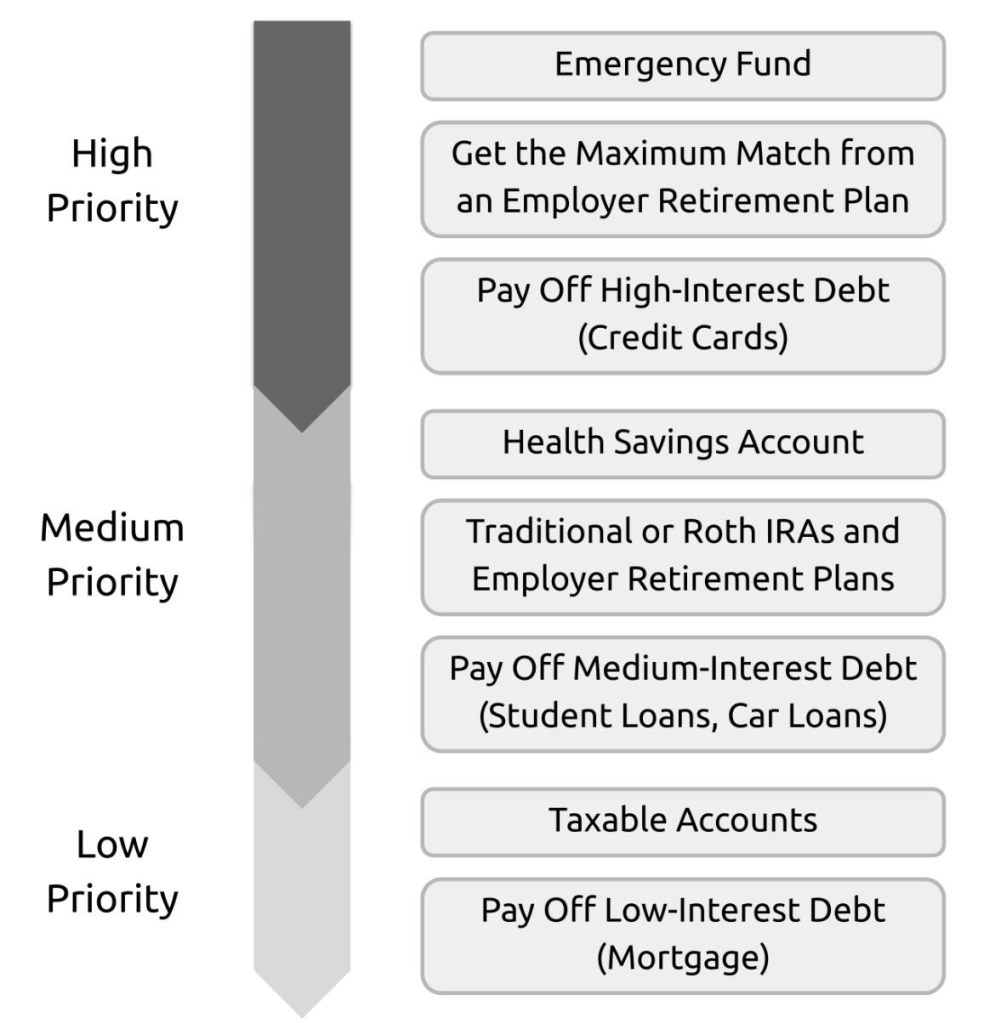
I found the above graphic in the wild and thought it was a fairly good prioritization of money priorites.
However, I would base the debt on interest rates but most people probably don’t know what their interest rates are on their debt. I really like the FOO by the Money Guys. However, they have caveats on it based on your risk tolerance, risk capacity, and how old you are. Personal finance is personal and nuanced.
There are competing priorities which can be based on a number of factors and winning with money doesn’t mean dieing with the most. I would argue at a certain point you should make less optimal money choices if it removes risk from the table. For example, if you have enough money to glide into a more than comfortable retirement then I would start paying off low interest debt like a mortgage so you never have to worry about not having a home.
I listened to a podcast with the author of “Die with Nothing.” He makes a similar argument and reminds the listener that at an earlier age than you think there will be a last time you can accomplish some tasks like skiiing, wakeboarding, flying, or traveling by living in hostels. Do those when you can so you have those memories in your old age and not regrets.
-
We were ready for major upheaval of our life. We were welcoming of it. However, my hiring agency has dragged their feet in providing me a firm offer. This could lead to losing our contract on our house and if this happens then we are back to the beginning. We do have an offer from the Army. There is a high probability we will be moving somewhere in the next few months.
However, the waiting game feels excruciating at times. Their lack of expendientcy makes you question your importance to their organization. WIll they treat me well when they refuse to onboard me well?
There is little sugguestion in this post but only the belief that little is guaranteed.
-
I am a consumer of financial literacy media. Books, articles, podcasts, and videos are read, listened to, and watched daily. One of the more interesting shows I have found is Kosher Money on Youtube. It is an Orthodox Jewish focused money show where the host interviews Jewish professionals in a variety of fields on money. Though I am personally not Jewish I think the Jewish people provide a lot of value on the topic and many other topics.
The professional interviewed today was Dr. Alper. She is a clinical psychologist and in her final question she spoke on the topic of how her grandparents asked “What can money do?” Whereas today she believes many people ask “What can money buy?” Though they are similar questions there is a distinct difference.
What can money do can be answered with the following:
- It can provide food for my family.
- It can provide an education for my children.
- It can allow me to spend more time with my family.
- It can provide security for when times are worse and comfort from just existing.
What can money buy can be answered with this set of answers:
- It can buy me that car.
- It can buy me that house.
- It can buy me that phone.
The first question provides needed items and items of enduring value. While the second question tends to feed our want for luxury. Money invested makes money and provides long term comfort that spending it immediately lacks.

