“The mass of men lead lives of quiet desperation.” Thoreau, Walden
What is worse, a tolerable workplace or a bad workplace? It isn’t a trick question; however, I think a tolerable workplace is worse.
In a tolerable workplace, you come in every day. You don’t enjoy it, but it could be worse. Many people spend their entire lives plodding away in a tolerable situation. You get your routines and rarely deviate from them.
When I worked in Korea, the work was tolerable. I didn’t have many friends, and because of the time difference, I didn’t talk to many people in the States. The winters were harsh, and I mostly stayed huddled inside. However, I made good money for the first time. The base I was at was a “hardship tour,” and almost everyone only spent one year there, so not many people were looking for enduring relationships. Most Airmen played video games all day when they weren’t working. It was the only time in my life where the boredom and loneliness was palpable. It was completely tolerable, but it wasn’t living.
In a bad workplace, you realize you need to do something to change your situation. A bad workplace provides motivation. That might mean going back to school. That might mean moving to another part of the country for a new job, which I did. For me, that also meant finding hope in FIRE and finding a pathway to stop working.
Without the terrible workplace, I could still be showing up and staring at clocks until traditional retirement. However, now I don’t have a tolerable life but a great one. I am challenged by living in a foreign land in interesting ways, including learning the language and culture and fixing problems.
Have you ever been motivated by a bad situation?
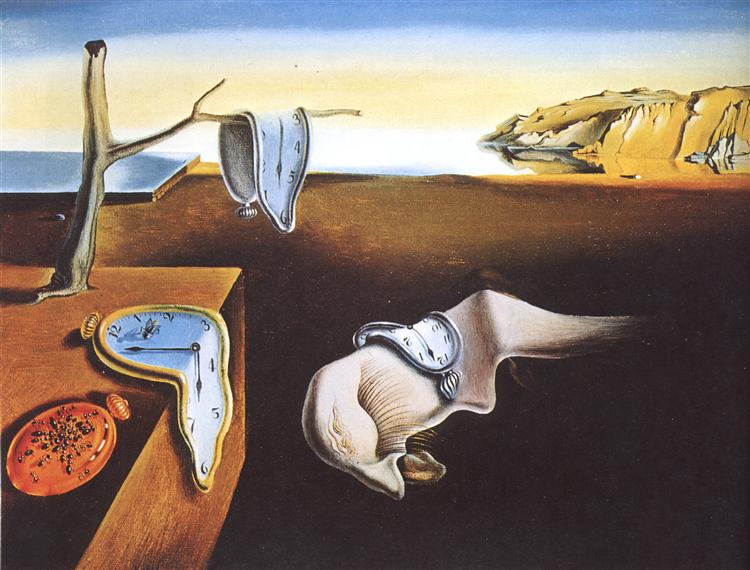
Ticking away the moments that make up a dull day
You fritter and waste the hours in an off-hand way
Kicking around on a piece of ground in your home town
Waiting for someone or something to show you the way
And you run and you run to catch up with the sun but it’s sinking Racing around to come up behind you again Sun is the same, in a relative way, but you’re older Shorter of breath and one day closer to death -Pink Floyd, Time
I’m always listening to music; progressive rock and progressive metal are some of my favorites. I tend to listen while I’m walking, and today I went to get groceries, enjoying the music and the walk. “Time” came on, and I was grateful that work is currently recreational.
With so little time on this Earth, and even less in good health, I no longer spend my days waiting for time to pass so I can go home. That was one of the worst feelings. I don’t mind working, but spending 40 hours a week in a library was sometimes okay and sometimes felt like torture. I once worked alone for three months on a book list spreadsheet in an office with no windows and little social interaction. There was hardly time for anything except a short hello to my future wife while some papers printed.
During that job as Chief of Acquisitions for a major library, I first started devoting myself to the hope that FIRE offered. I was desperately trying to find other work in the federal government, even if it meant moving to the other side of the country. I stayed in that position for two years because I didn’t want to leave the federal government and was waiting for the right opening.
Eventually, I found a position in Oklahoma as director of a small Air Force library, where I could be as social as I wanted to be.
Each dollar I made gave me a little more freedom, including the freedom to move across the country for a new job. When I was Chief of Acquisitions, my life savings would have been gone within a year without income, but slowly, then rapidly, we reached financial independence.
Now financial independence gives me all the time in the world to enjoy my wife and daughter, earn a slightly better return working with real estate, write this blog, talk with family in the US, enjoy the perfect weather of Cuenca, and even, GASP, work a little.
No more staring at the clock in a windowless office, waiting 20 minutes to go home. I own the most important thing: my time.
I never wanna be old And I don’t want dependence It’s no fun to be told
There is nothing quite as disappointing as someone who feels they “deserve” something, especially a luxury good. They never learned the lesson from Kristy Shen that money is worth bleeding for, not because it can buy you luxury goods, but because it can buy you essentials like food and a roof. You have to have some money.
One essential need is a roof, but many young people refuse to give up the luxury of living by themselves, and housing is too expensive for that.
National averages for a 2-bedroom rental are roughly $1,750 to $1,900 a month. Apartment List put the national median 2-bedroom rent at $1,865 in Q1 2026. Zillow’s average for a 2-bedroom is $1,795. The 2025 Fair Market Rent for a 2-bedroom averaged $1,749. Most of these figures cover apartments, so a stand-alone house often runs higher, and the range across cities is wide. Utilities (electric, gas, water, internet) for a 2-bedroom house typically add about $250 to $400 a month.
Roommate’s share
Roommate pays/month
You save/month
You save/year
50% (equal split)
$1,050
$1,050
$12,600
That is an outrageous amount of savings for simply sharing a house. Investing $1,050 a month in the S&P 500 at its 13% annual return over the last 15 years would have grown to about $577k, which is enough for many people to retire somewhere like Ecuador.
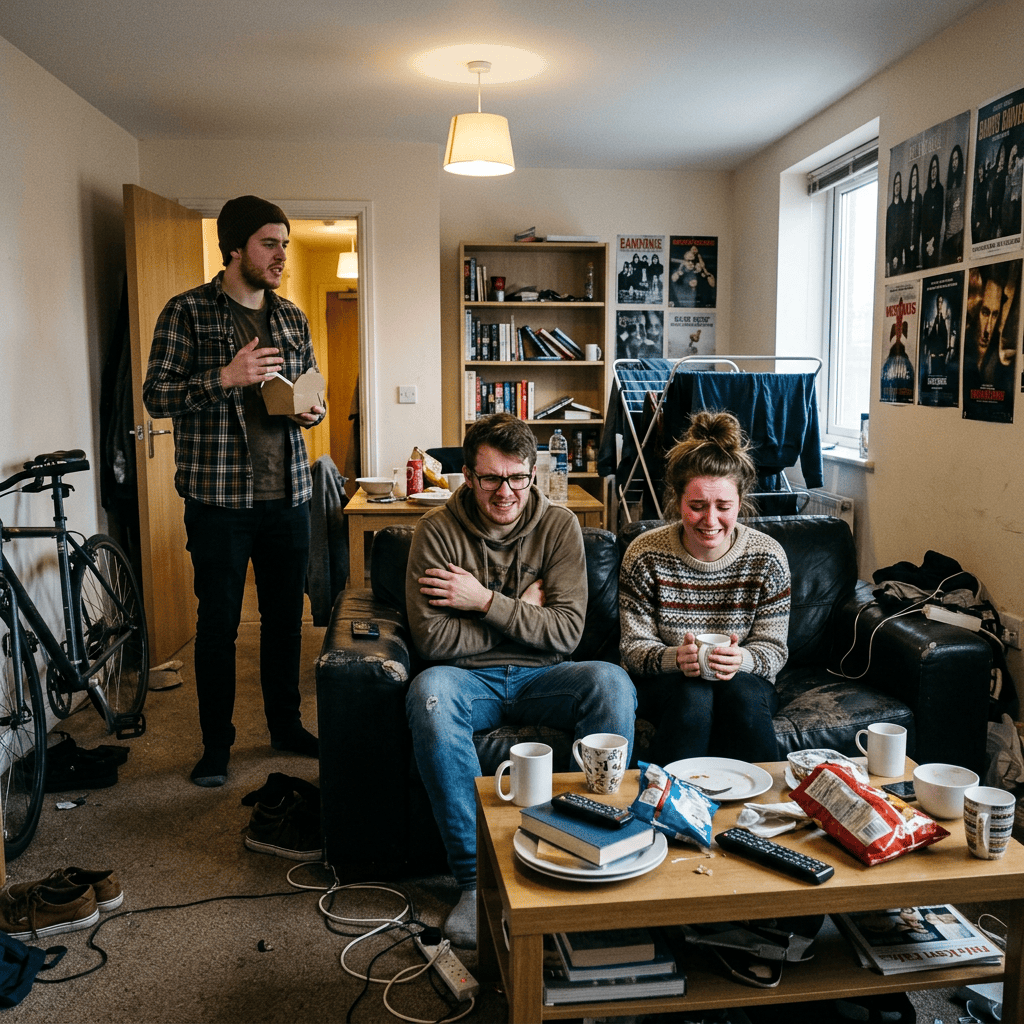
Three roommates gather in a cluttered living room as two react emotionally over coffee and snacks.
In Ecuador, almost every house is multigenerational because it makes financial sense. The house at the end of my street has grandma, three adult siblings who are parents, and five or so teenagers and younger kids. They recently built two small apartments at the back of the house for some of the older teenagers. It is a beautiful family full of love, and we hope to have our own similar housing compound one day, probably further out in the country.
I think the primary reason housing prices in the US are terrible is that there isn’t enough supply. Over the years, houses have gotten larger and larger because builders make more money on larger houses. NIMBYs also don’t want economical housing to lower their home values, despite the need. The last time small houses were built at scale was in the 1950s. Houses of 1,000 sq ft with 2 bedrooms and 1 bathroom need to be built, but they face political and economic headwinds.
Coming back to my original point: one person can’t change the housing economy, but you also shouldn’t destroy yourself financially with high rent and utility payments when you could have roommates. Most people do not like roommates, and you might get a bad one, which can be terrible. Still, a bad roommate teaches many valuable lessons about assessing and managing others.
There are many different flavors of Financial Independence, and I have taken parts from many of them.
ExpatFI promotes moving to a lower-cost-of-living country to arbitrage your finances and retire earlier or a little earlier. There are a dozen different items you need to consider, like visas, languages, weather, and currency risk. Our move to Cuenca has been one of the best choices we have made.
LeanFI promotes stoicism and simplicity. I’m naturally a pretty frugal person. I tend to enjoy music, reading, writing, and learning. None of these things are very expensive. You generally do not get to early retirement as a librarian without being pretty frugal. However, I have noticed that the longer I am retired and the more our net worth increases, the less frugal I have become. I enjoy the convenience of eating out, weekly cleaners, a gardener, preschool, and my daughter participating in ballet and speech therapy to help with her Spanish. These items are also much less expensive than in the States. We have met other families who I think take this to the extreme in Ecuador by having live-in nannies and chefs who cook all their meals. For us, we prefer to have our privacy.
Now, with our jobs, I guess we are technically CoastFI because almost all our expenses are covered by our jobs. Adding in a couple of part-time jobs helps smooth the ride, and I don’t feel obligated to try to save a large percentage of our income anymore. Our portfolio is free to work and compound in the background.
We also have real estate and a plan to buy more. I don’t think there is a specific FI for people with rentals, but despite the extra workload, I think it is one of the best ways to be financially free. It is great to have some small income coming in, whether that is a pension, a part-time job, or a few rentals. Something that moves independently from the stock market, which might take a little work.
I also plan to only have a few rentals at most and focus on paying them down faster. The primary reason for this is more income or cashflow because I don’t have a loan, and generally less risk. Also, it is less work. Having 3 paid rentals you self-manage where you might net 2–3k after insurance and taxes is a great tradeoff. There is also the possibility of having someone manage them for me at some point.
Rentals also can be nightmares. You hear about repairs, and those do come along and can sometimes be expensive, but the real danger is buying an alligator. This is generally a property that negatively cashflows, meaning it doesn’t pay for itself. I have a friend who tried to get into real estate, and they barely make any money off their rentals in good months, and then a major repair comes along, and they need to get loans to pay for the repairs. They can’t sell the houses, and they just sit on the market with no one wanting to do the repairs themselves. Rentals are like chainsaws: powerful, but you need to know how to use them.
Today is the first day of a new job for me. It is a very part-time remote librarian of record position, which means I will be there to help students find resources and assist with accreditation. My wife is also doing something similar, and combined we will be working about 25 hours per week, which seems about right.
With this change, we are now 100% stocks once again, as our jobs cover our expenses and we want our portfolios to grow as much as possible. To paraphrase JL Collins, our incomes are once again serving as a ballast, providing stability to our financial lives. One way of thinking about this is that each $1k earned a month replaces $300k in bonds if they return 4%. This is a lot of power in a little income, especially if you are on the leaner side of FIRE.
We are also trying to purchase another rental property, and probably a few more over the next few years. Our current rental property performs very well but requires some work. It is also a type of work I enjoy doing, and over the years I have had a half dozen roommates while househacking and have successfully rented out our current house remotely for about 2 years. One reason I like real estate is that it provides a monthly check to your bank account, and spending that feels easier than selling shares to do the same thing. This is one reason I prefer real estate that has cash flow rather than focusing primarily on appreciation, like some real estate investors do. I want my real estate to mostly pay for itself, including maintenance, loans, insurance, and taxes.
I’ve been reading “Coach” Chad Carson’s book, The Small and Mighty Real Estate Investor. He also makes informational videos on YouTube, which I have been watching for a while. There are also a few other real estate investors I have been watching for some time that he introduced me to. Though definitely more involved than index funds, I enjoy making contracts, managing tenants, managing contractors, and purchasing single family home real estate.
Rich Carey who owned a 25 house real estate empire in Montgomery, Alabama while stationed overseas in Europe has always been a favorite of mine. He emphasizes having good people you can trust and good systems to succeed from afar. Definitely our reliable and fair handyman has been instrumental in the entire process from repairing items, to identifying potential problems, providing an eye on the property, and giving his opinion on potential new purchases.
I believe it was JL Collins who said he preferred different wording for the acronym FIRE. Instead of Financial Independence, Retire Early, he preferred Financial Independence, Recreational Employment. This updated wording better reflects treating work like a hobby, and how once you have financial independence, work flows in and out of your life based on your wants instead of you needing it to survive financially.
Health 907 Rent 450 Food 437 Restaurant 320 Preschool & Aftercare 278 Alcohol 178 (This does include some meals we ate out as well, which inflates the number.) Housecleaner 90 Household 86 Transport 70 Other 35 Social Life 28 Education 96 Beauty 15 Apparel 3
Total: 3099
US Estimated Equivalent (Used rural Missouri numbers where we used to live, where possible)
Health 2740 (twice-weekly speech sessions, insurance, and uncovered medications like Ozempic) Rent 1000 Food 800 Restaurants 760 Daycare 1000 Alcohol 360 Housecleaner 400 (weekly home cleaners) Household 170 Transport 400 (with paid-off cars) Other 35 Social Life 70 Education 400 (private Spanish lessons, 1x/week) Beauty 30 Apparel 10
Total: 8175
These are our July expenses in Cuenca, and for fun we estimated how much a similar lifestyle would cost in the US since we’ve expanded our lifestyle since moving here. In the US equivalent section, we added some details to help explain the major expenses in each category. A lot of these expenses we simply wouldn’t have bought for various reasons, like the housecleaner or Spanish lessons — mostly they wouldn’t have been worth the cost for us. We also receive better medical care in Ecuador and eat much better. At all times we have fresh fruits and vegetables in the house because they’re so cheap and great here. In the US, we would likely snack on chips or something less healthy instead. Better living and food has led to my wife losing 47 pounds and me losing 30 pounds in the last year. This is also a good time to note that August 4th was our one-year “Cuencaversary.”
We’re spending 62% less than the US-equivalent lifestyle — $5,076/month, or about $60,900/year. That’s not “prices are cheaper”; that changed our FI timeline.
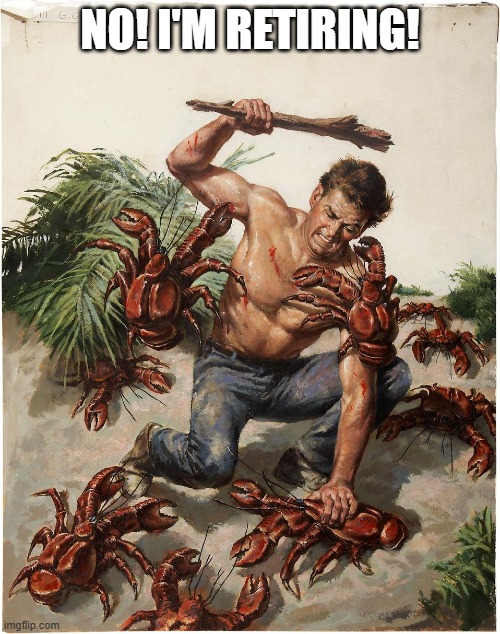
Crab bucket mentality is a social behavior where someone tries to sabotage, pull down, or undermine someone who is trying to succeed or improve.
The idea is pretty simple. If you put one crab in a bucket, it will simply climb out, but if you put a bunch of crabs in a bucket, the other crabs will pull down the one trying to escape.
You see this in a couple of ways in society in regard to FIRE. First is the perpetual consumer. You mention something about spending less or retiring early, and the reaction isn’t curiosity but chastising.
“I could never live without X. I have to have Y. Life is too short for me to not spend all of my paycheck.”
You’re now in an awkward conversation where you’re being accused of living a bad life. Next time you’ll just mind your own business and make up something. Or there might be curiosity, but it’s only because they think you got lucky and didn’t earn it.
“Did you win the lottery? Did you get an inheritance?”
However, as annoying as talking to consumers can be, some of the worst people to talk about FIRE with are, ironically, people in the FIRE forums and FIRE subreddits online.
They doubt you can do it, in other ways. You say “I’m retiring with 1 million,” and like the crabs they are, they pull you back into the bucket, saying “Oh, you need 2.5 million to retire.” You might reply, “Well, I only need 1 million,” and then the conversation shifts once again to how it’s irresponsible, or that you need 10 vacations a year, or don’t you have a kid, or they’re completely unwilling to work part-time if you get three great depressions in a row. They would rather work another 15 years until traditional retirement age, or if they’re feeling risqué, retire at a brisk 60.
There is also the Internet FIRE police who want to fight you about defining “retired.”
“You have a rental. That is not really retired. You’re actually still in the crab bucket with us!”
Or you might work a few hours a week or have a hobby job, maybe something part-time in a less stressful field to expand your spending lifestyle, while your portfolio still does the heavy lifting or can compound a little more in the background.
I have just started saying I’m financially independent (FI) and leaving off the retired early (RE) entirely. If someone doesn’t understand, it opens the door, and then they can inquire further.
Is frugality something you’re born with, or something life teaches you? I think the honest answer is both — but the way each one works is more interesting than the debate usually gives it credit for.
The Marshmallow Study
The infamous “marshmallow” study tested young children on their ability to delay gratification for a bigger prize later. This is a skill integral to investing at a later age. Children who successfully delayed their gratification were studied later and did unusually well financially. This hints that frugality and the ability to invest might partly be nature.
But here’s the interesting point: many of the kids who succeeded in this experiment still wanted instant gratification. They didn’t out-will the marshmallow. They found other ways to occupy themselves — playing games, singing, looking away, pretending it wasn’t there.
This matters a lot for how we think about frugality in adulthood. Trying to stoically abstain from spending might be more difficult than abstaining by entertaining yourself in a more frugal way. The kids who succeeded weren’t fighting the urge head-on. They were distracting themselves from it. If that’s the actual mechanism, then “just have more willpower” is bad advice. The better advice is: find something else to occupy yourself with — the budgeting spreadsheet, the DIY project, the game of seeing how low you can get the grocery bill — instead of white-knuckling your way past every purchase.
A single white marshmallow sitting on a clean white surface
The Great Depression, the Great Financial Crisis, and Me
As a contrasting point, people who lived through the Great Depression were changed, or scarred, forever. Everyone’s heard of the grandparent who hoarded food or other goods for the rest of their life because of what they went through.
To a lesser degree, I wonder if something similar happened with the Great Financial Crisis. I graduated college in 2009 and couldn’t find a job for new graduates. I ended up going back to school. That was also the year I lived in poverty. Since then, I’ve saved around 50% of my income and am now financially independent.
I wonder if I would have turned out the same without the GFC, and without that lean year. My guess is some of it is biological — the raw material was probably there — and it just needed the right conditions to bring it out.
I should add an important detail, though. I was hungry that year, but I had a family safety net. I had people I could return to a state over, and eventually I did. That’s a very different experience than true poverty, where there’s no floor under you at all. I think that safety net is part of why the lesson I took away was “save and build something secure” rather than something more desperate. Knowing the fall had a bottom probably let me treat that year as motivation instead of trauma.
Instability Doesn’t Always Teach the Same Lesson
Here’s the part that keeps the story from being too tidy: instability doesn’t always cause frugality. In some people, it produces the opposite — compensatory overspending once resources are finally available.
When I worked for the military, it wasn’t unusual for a young Airman with a rough childhood to spend an entire paycheck and bonus on a flashy vehicle with a predatory interest rate. Same starting ingredient — a hard upbringing — completely different result.
So scarcity by itself isn’t the lesson. Something about how the scarcity was experienced determines whether it teaches “delay pays off” or “grab it while you can.” My 2009 didn’t just install a general fear of poverty — it seems to have installed a specific habit, a savings discipline, more than a permanent anxiety. And I think the safety net mattered here. I knew the fall had a bottom. That Airman’s childhood, by contrast, may have had no floor at all — no family to return to, no version of the story where things were guaranteed to get better. Maybe that’s part of why the same rough patch can teach one person “save for the bottom that’s coming” and teach another person “there is no bottom, so take what you can get now.”
Nature probably loads the gun. But whether a hard season in life makes someone frugal or makes them overcompensate later seems to come down to what that hard season actually taught them about whether patience gets rewarded or punished.
A classic Dodge Charger R/T drives through a busy city street lined with shops and pedestrians
Someone online was writing about a date they went on. The guy was hesitant to pick up the check. They drank only water. He wanted to split the entree even though it was just a cheeseburger and she didn’t like cheeseburgers. When it was time to leave he wanted all the leftover fries for later. He wasn’t starving or poor. Actually, he was an aerospace engineer who bragged about his hundreds of thousands portfolio.
He was cheap, and the reason he was cheap is because his frugality greatly limited the relationships in his life. On a date, he had an obligation to pay for the meal. It seems he didn’t like this obligation. If he was just frugal, then he would have turned down the date and stayed home to eat, or he could have fixed a good meal for the both of them.
This isn’t an absolute rule, but more of a spectrum. I think as your net worth increases and your money begins making real money, it’s important to use this easily obtained invested money to spend a little more, especially on relationships. If you’ve saved up considerable wealth to where your investments are bringing in real income, or you’re financially independent, then you’re probably at least a little frugal compared to your peers and should start exercising this muscle. Maybe buy your friends lunch or pick up dinner. It doesn’t have to be extravagant. I don’t enjoy traveling, but my wife does, so she went to a destination wedding in Greece to visit old friends. After you have your nest egg, don’t spend it down, but see how it feels to spend more of what it makes. Remember, though: it’s first the nest egg, then the life.
There’s actually a name for this idea, and it’s more rigorous than just eyeballing recent market returns: the guardrails withdrawal method (Guyton-Klinger). Instead of locking in a fixed 4% or 4.7% forever, you set an initial withdrawal rate, then adjust it up or down based on how your portfolio is actually doing relative to where it started. If a hot stretch pushes your withdrawal rate below your lower guardrail — meaning your portfolio grew faster than your spending — you give yourself a raise. If a downturn pushes it above your upper guardrail, you pull back for a while. It’s a withdrawal rate with shock absorbers, built to flex with the market instead of ignoring it. That’s a better anchor for “spend more” than citing a hot decade of returns, because it’s a claim about your specific position relative to your specific number, not a bet that recent market performance repeats. If you’re financially independent and durably ahead of where your original plan needed you to be, that’s the system telling you it’s fine to buy the lunch, book the trip, pick up the check.
Financial Independence is the Important Part of FIRE
Financial independence is when the money your assets make replaces your income, meaning you no longer need to work.
I think the most important thing about financial independence is that it’s a progressive concept — you get more and more benefits the further you go on the spectrum. Someone with $10k has more independence than someone in debt. They can afford to take a couple of unpaid days off or go a month without work if they need to. A person in debt needs every cent they can make.
Expenses matter too. It’s the other side of the balloon. Someone with lower expenses and the same amount of money has more independence than someone with higher expenses. For example, if two people each have $100k, the one who spends less can make it last longer.
Things get messier with the RE part — is it really RE if you work a part-time job, or rent out a couple of houses? It’s not technically fully retired, and some people love to point that out. Maybe you have a hobby that brings in a little money. Some would say you’re still “working” even if it’s just a couple hours a week.
But that argument misses the point. RE is a label — a yes/no switch people like to argue about. FI is the thing that’s actually real. It’s the spectrum you’re moving along every time you pay down debt, cut an expense, or add to your net worth. You don’t need someone to certify you as “retired” for that progress to count. You just need to keep sliding down the spectrum toward more freedom.