There is nothing quite as disappointing as someone who feels they “deserve” something, especially a luxury good. They never learned the lesson from Kristy Shen that money is worth bleeding for, not because it can buy you luxury goods, but because it can buy you essentials like food and a roof. You have to have some money.

One essential need is a roof, but many young people refuse to give up the luxury of living by themselves, and housing is too expensive for that.

National averages for a 2-bedroom rental are roughly $1,750 to $1,900 a month. Apartment List put the national median 2-bedroom rent at $1,865 in Q1 2026. Zillow’s average for a 2-bedroom is $1,795. The 2025 Fair Market Rent for a 2-bedroom averaged $1,749. Most of these figures cover apartments, so a stand-alone house often runs higher, and the range across cities is wide. Utilities (electric, gas, water, internet) for a 2-bedroom house typically add about $250 to $400 a month.

Roommate’s shareRoommate pays/monthYou save/monthYou save/year
50% (equal split)$1,050$1,050$12,600

That is an outrageous amount of savings for simply sharing a house. Investing $1,050 a month in the S&P 500 at its 13% annual return over the last 15 years would have grown to about $577k, which is enough for many people to retire somewhere like Ecuador.
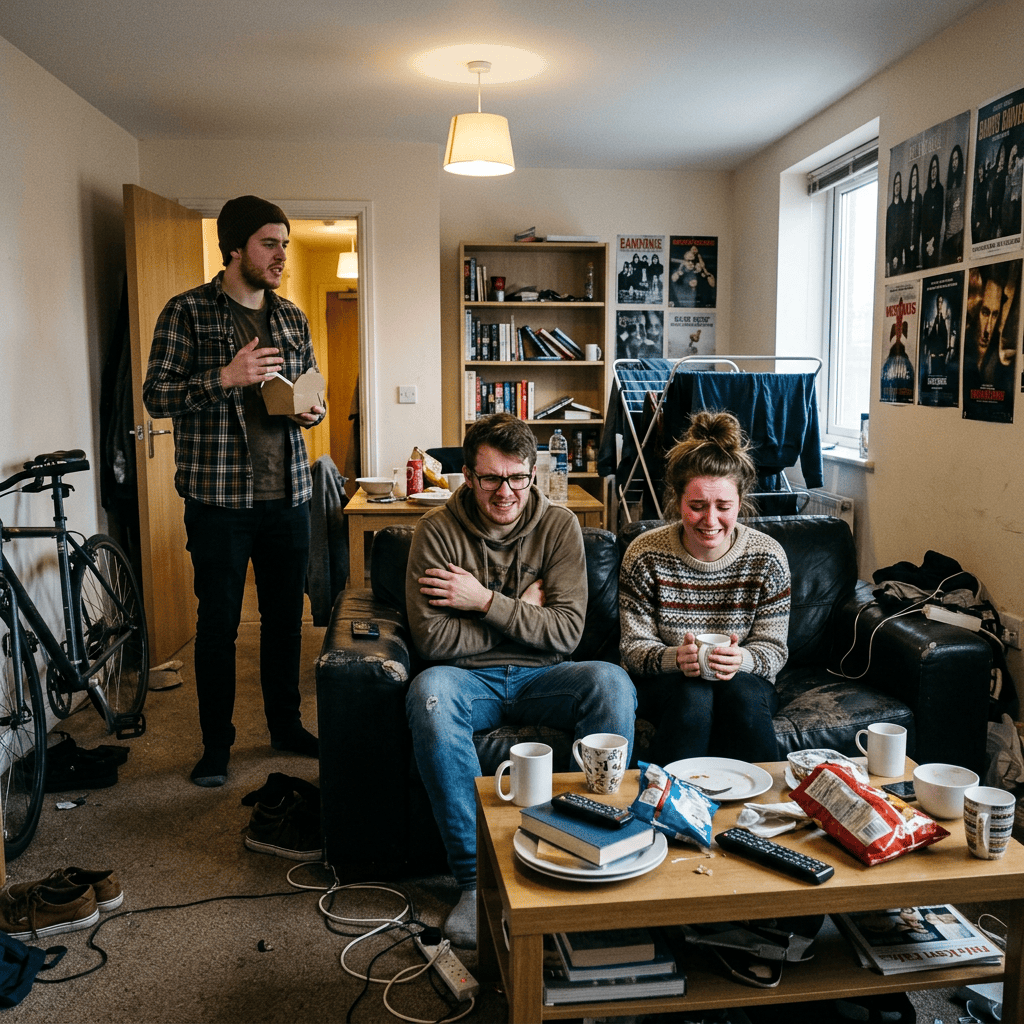
Three roommates in a cluttered living room, with two seated and visibly distressed.
Three roommates gather in a cluttered living room as two react emotionally over coffee and snacks.

In Ecuador, almost every house is multigenerational because it makes financial sense. The house at the end of my street has grandma, three adult siblings who are parents, and five or so teenagers and younger kids. They recently built two small apartments at the back of the house for some of the older teenagers. It is a beautiful family full of love, and we hope to have our own similar housing compound one day, probably further out in the country.

I think the primary reason housing prices in the US are terrible is that there isn’t enough supply. Over the years, houses have gotten larger and larger because builders make more money on larger houses. NIMBYs also don’t want economical housing to lower their home values, despite the need. The last time small houses were built at scale was in the 1950s. Houses of 1,000 sq ft with 2 bedrooms and 1 bathroom need to be built, but they face political and economic headwinds.

Coming back to my original point: one person can’t change the housing economy, but you also shouldn’t destroy yourself financially with high rent and utility payments when you could have roommates. Most people do not like roommates, and you might get a bad one, which can be terrible. Still, a bad roommate teaches many valuable lessons about assessing and managing others.

Posted in

2 responses to “Housing is Too Expensive and Roommates are Worth Retiring Early.”

  1. singvestor Avatar

    A truly controversial post – I like it! I had flat mates during uni, but it is very challenging for me as rather introverted person. Flatmates are not for me. As I also wanted to be financially independent, I decided that housing should never cost more than 20% of my net salary. Not easy, living in one of the most (according to some statistics the most) expensive city in the world (Singapore). Most people laughed at me, claiming this was impossible.

    Now I am financially independent and still live in one of the most expensive places (Switzerland). I still work for fun, because one-more-year-syndrome and because the mission of our small company has not been completed. My apartment currently costs <15% of net salary. Most of my friends spend 30-50% of their income on housing.

    My techniques were:

    Creativity: I looked for the oddballs in the housing market, places that were in not so desirable locations, but close to work (I hate commuting). Once I lived in a penthouse right in the red-light district, my colleagues found the area to be “unsafe”.

    Downsize: for two years or so I lived in a shoebox studio. Sometimes they can be quite cheap if you go for the really tiny ones.

    Market research: in-depth and excessively combing through the listings to find the ones with little info, bad photos or wrong descriptions, places that might be overlooked for some reason… etc.

    Getting the company to pay for housing: 5+ years I went on international assignment with free housing. This track needs a management career, but there are also blue collar workers who can make use of this option (e.g. offshore workers, maintenance / field technicians… anyone who needs to travel for work for prolonged periods of time does not need a own place to stay)

    International arbitrage: for remote workers or in between jobs this is a very attractive option. After I became a basic version of FI I just bummed around cheaper countries and worked remotely for my current company. In my experience, many Airbnb hosts get tired of changing bedsheets very fast and are open to cheap long-term rates, especially in the offseason. Also it is easy to meet other international people who have tips on who has a temporary flat to rent. As you have described in your posts, not only housing is cheaper, mostly everything is cheaper.

    Live in hotels: sometimes I lived in hotels for months on end during assignments. In some cities this is a surprisingly good strategy – worth investigating. Sometimes there are good deals to be negotiated and it can work out cheaper than an apartment in some places (plus: no utilities, free food, free gym etc).

    So I would say, it is possible to have cheap rent for introverts. But surely, it is easier with flatmates…

    Like

    1. Millionaire Librarian Avatar

      Thanks for your detailed reply.

      I have also lived in bad parts of town (Prices about quadrupled since 2015) and when I worked overseas for the federal government/military they paid for my housing. If you would prefer either of those then I wouldn’t blame you. A major part of the reason we chose Ecuador was that we could rent here cheaply.

      I’ve said it in posts before but housing and cars are the two biggest expenses and they are generally reoccurring. Bringing those down as far as you can is the best way to create the space you need to invest.

      Like

Leave a comment